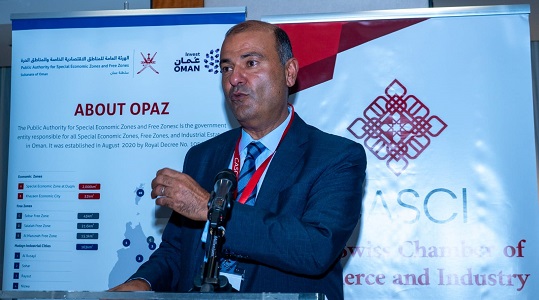
The Secretary-General of the Union of Arab Chambers, Dr. Khaled Hanafy, affirmed during his participation in the sixteenth session of the United Nations Conference on Trade and Development “UNCTAD”, which was held in Geneva, Switzerland, from 20 to 23 October 2025, that “Strategic logistics centers and special economic zones as catalysts for trade connectivity and growth” is a relevant and important topic at this time for the Arab world, which lies at the heart of global trade, spanning the three continents of Asia, Africa, and Europe. He noted that today, three of the world’s most important maritime passages — the Suez Canal, the Strait of Hormuz, and Bab al-Mandab — are located within our region. These routes handle more than 30% of global container traffic. This strategic position makes logistics and special economic zones (SEZs) a strategic necessity.
Dr. Khaled Hanafy chaired the symposium organized by the Arab-Swiss Chamber of Commerce and Industry on the sidelines of the sixteenth session of the United Nations Conference on Trade and Development “UNCTAD”, under the title: “Strategic Logistics Hubs and Special Economic Zones – Catalysts for Trade Connectivity and Growth.” The session was attended by Samir Majoul, President of the Tunisian Union of Industry, Trade, and Handicrafts and President of the Union of Arab Chambers; Kamel Rezig, Algerian Minister of Trade and Export Promotion; Ambassador Hisham Biyoud, Permanent Representative of the League of Arab States to the United Nations Office in Geneva; and Hilda Al Hinaei, President of the Arab-Swiss Chamber of Commerce and Industry. Also present were a number of Arab permanent representatives accredited in Geneva, representatives of Arab missions, several businesspeople, and representatives of international organizations concerned with economic affairs.
He said that within the Union of Arab Chambers, “We believe that logistical infrastructure and the development of special economic zones are essential to achieving Arab economic integration and expanding intra-Arab trade, which currently stands at about 11% of total Arab trade — a figure far lower than that of other regional blocs such as ASEAN or the European Union.”
Dr. Khaled Hanafy pointed out that “There are currently 5,400 special economic zones around the world. The Arab region is rapidly adopting this model to attract foreign direct investment, create job opportunities, and diversify economies beyond the hydrocarbon sector. However, special economic zones must evolve from being mere tools for encouraging investment into instruments of industrial policy that drive innovation, technology transfer, and sustainable value chains. Therefore, the private sector must be at the core of this transformation. At the Union of Arab Chambers (UAC), we are actively working to empower Arab chambers and strengthen cross-border cooperation between public institutions and companies to create the necessary regulatory and financial conditions for growth.”
He considered that “Logistics and special economic zones are the backbone of the Arab economic transformation across all regions. There is an urgent need to unify regulatory frameworks and simplify customs procedures across Arab special economic zones to enhance the integration of regional supply chains. In the future, multimodal connectivity will enable linking the ports of the GCC countries with the manufacturing corridors in the Maghreb and trade routes in the Mashreq.”
He concluded by saying that the Union of Arab Chambers stands ready to facilitate public-private partnerships and coordinate efforts between chambers, investors, and policymakers to build a more integrated and competitive Arab economy.
Source (Union of Arab Chambers)
